Majors and Generalizations
Majors and Generalizations
Cognition is navigation of a world-model manifold where intent is the tangent vector, risk is the curvature, simulation is forward integration along geodesics, and generalization is the hierarchy of charts at different scales. One manifold. Its intrinsic geometry does all the work.
Unpacked
The geometric ground, the pre-symbolic middle layer between raw experience and symbols, is organized as a hierarchy of world-state manifolds ranging from maximally specific (this cup, this moment) to maximally general (objects affected by gravity). Sensory input acts as an index key that retrieves not one manifold but an entire chain, ordered by specificity.
This essay extends a series. Frontier Models Do Not Think argued the architectural case against transformer reasoning. AI Can’t Help Mawmaw introduced Levin’s morphospace and the problem of fluid cognitive mode-switching. Geometry Saves Mawmaw proposed Riemannian geometry as the substrate for goal-space navigation. Cargo Cult Civilization diagnosed counterfeit cognition as an energy problem. Eksterulo showed that the failure to relate and the failure to reason share a root cause. Ground Beneath the Map identified the three-layer stack (territory, geometric ground, symbols) and the missing middle layer.
This essay walks in circles around the question that essay left open: How does the geometric ground generalize?
Generalization extends downward, towards specificity
You don’t generalize from cups. You specialize from physics.
When I say “generalization,” I mean the move from this cup falling off this table, right now to unsupported objects fall. The standard story says you collect enough particular experiences and induce the general rule. I think that it’s mostly backwards, for much of what we call knowledge (or human capacity): the general structure comes first, and experience sharpens it downward into the particular.
Your birthright tabula rasa is a mostly smooth, flat Euclidean plane. Then things happen.
The general end of the chain is partially populated at birth, installed as Evolutionary Firmware. Gravity isn’t learned from dropping cups. It’s pre-installed in our hind brains. Object permanence at the most basic level is pre-installed. The brainstem, cerebellum, proprioception, edge detection, the startle response: hundreds of millions of years of organisms encountering territory, with the successful compressions baked into hardware. These firmware manifolds have coarse geometry already in place.
What experience does is twofold: it sharpens the metric on the pre-installed manifolds, and it extends the chain toward the specific end. The toddler pushing cups off the table isn’t building the general manifold for gravity from scratch. She’s refining the metric on a manifold that evolution already roughed in, while simultaneously growing new, specific manifolds (this cup, this table, this weight) that extend the chain downward toward particularity.
The chain grows from the general toward the specific. You don’t induce upward from instances. You differentiate downward from factory-installed firmware.
This aligns with the “metric is scar tissue” commitment at two timescales. Evolutionary firmware is species-level scar tissue, the metric learned by the lineage across billions of years of things going wrong. Developmental experience is individual scar tissue, the metric learned by the person. Same mechanism, different timescales.
All day, every day
Your system runs prospective simulations, forward predictions of “what happens next,” across manifolds in the chain. The simulation budget tracks your risk posture: cheap run-forward when the stakes are high and speed matters, richer and leisurely exploration when a t-rex isn’t trying to eat you.
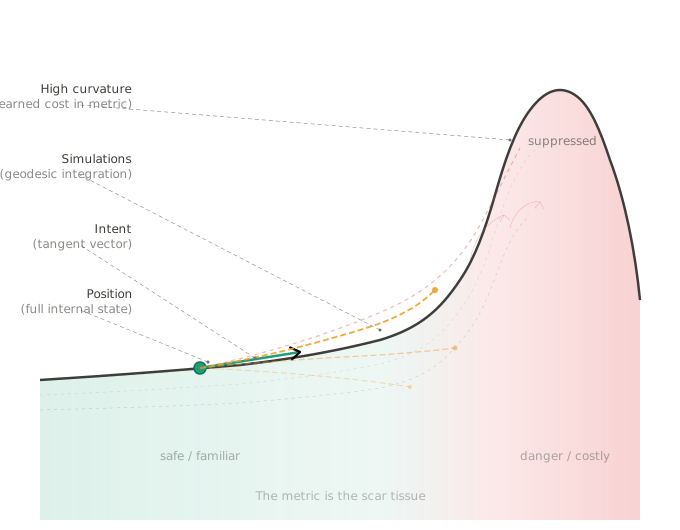
Intent and risk are intrinsic to the manifold’s own geometry. Intent is the tangent vector: the direction you’re moving through world-model space, where you’re trying to go. Risk is the curvature: how fast nearby trajectories diverge toward dangerous regions.
Value is baked into the metric
Curvature in raw differential geometry is value-agnostic. It describes divergence of geodesics, full stop, with no opinion about whether that divergence is bad. So here’s the commitment: value is encoded in the Riemannian metric itself, not painted onto a neutral geometry after the fact.
Formally: in the Riemannian metric gᵢⱼ, the distance element ∑ᵢⱼ gᵢⱼ dxⁱ dxʲ measures not physical distance but cost. In safe, familiar regions, gᵢⱼ keeps distances short. Near a cliff, gᵢⱼ blows up: even a small physical step dx becomes an enormous geometric distance ds. The metric warps space so that dangerous regions are geometrically far even when they’re physically near.
The metric was learned through embodied experience, evolutionary and developmental. The manifold’s distances and curvatures were shaped by what hurt and what worked. A region of high curvature near a cliff edge is high-curvature because organisms that treated it as flat stopped contributing to the gene pool.
Value is sedimented into the geometry. The manifold is the residue of billions of years of things going wrong for things that are now dead because they couldn’t outrun the t-rex. The metric is the scar tissue.
A toddler’s manifold has a different metric than an adult’s, not because the world changed, but because the toddler hasn’t yet learned which regions are costly. The metric is immature. Toddlers walk off edges because their geometric ground hasn’t yet encoded the cost into the curvature.
(Eleanor Gibson showed this in 1960. Crawling infants avoid a visual cliff; pre-crawlers don’t. And it’s crawling experience specifically, not age, that predicts the avoidance. That’s a metric-refinement story. The geometry sharpens through the embodied experience that exercises it.)
There is no external loss function, and no bolted-on value system. The manifold is the accumulated record of what mattered.
This collapses the architecture from “three spaces” (risk, intent, ground) to one space and its intrinsic geometry. No circular dependency between intent and world-model, because they’re the same space at different derivative orders. Your tangent vector determines which forward simulations are locally accessible. The curvature, encoding learned cost, determines which trajectories are dangerous.
The simulation whose predicted trajectory best fits the manifold’s local geometry everywhere at once wins. This fit-evaluation, resonance, is a field evaluation across the whole topology, not a scalar loss at a single point. “Did I predict the next token correctly” versus “is this trajectory consistent with the curvature of reality.” Those are different operations in different phyla.
This is cognition. Symbols come later, if at all.
On indexing: the query is your position
Sensory input is only one component of the manifold generality chain index key. The full query is your entire internal state, cognitive, emotive, proprioceptive, or some compressed residue of it. (An embedding, kinda. Maybe.)
This dissolves the indexing problem rather than solving it. The query isn’t a discrete key into a discrete index. It’s a position in a high-dimensional state space, and the manifold hierarchy responds to that position the way a landscape responds to where you’re standing: locally. You don’t search the manifold. You’re already on it. Your full internal state is your coordinates, and the local geometry at those coordinates determines what’s accessible.
This is why the same cup on the same table produces different cognition when you’re angry versus calm versus exhausted. Sensory input identical. Coordinates different, because the emotive-proprioceptive dimensions shifted. Different position, different local geometry, different simulations. I’m not a math guy but I believe this is why RNFs are interesting.
The full internal state is absurdly high-dimensional, but most of it is redundant or irrelevant at any given moment. What does the work is a compressed projection, an embedding, that preserves the dimensions that matter for the current region of the manifold. Which dimensions get preserved may itself be determined by where you are. The manifold selects its own query basis.
The system is self-indexing. There is no homunculus and no lookup table. You’re walking on the manifold, and being on the manifold is the query.
Open questions
Can the residue work? General manifolds are what remains invariant after varying details wash out. The architecture requires them to be functional: to run simulations, generate predictions. How does erosion produce something that can do work, not just something that persists? The firmware commitment partially answers this for the general end (natural selection tested those manifolds). The individually-learned specific manifolds still need the account.
Falsifiability. The thesis needs at least one specific, testable prediction. Candidate: disrupting someone’s tangent vector through world-model space, without changing their knowledge, skill, or sensory input, should change which generalizations they make, not just how quickly they act. Depression as tangent-vector collapse may be the natural experiment.
Prior art
Individual components are well-established across independent traditions. The specific assembly, and its application as a structural diagnosis of transformer failure, is novel.
- Shepard (1987): Generalization follows geometric law in psychological space
- Gärdenfors (2000): Conceptual Spaces — concepts as regions in geometric quality spaces
- Llinás (2001): Brain evolved for prospective simulation; cognition is internalized motor prediction
- Friston: Active inference — hierarchical world-models, variational free energy on manifolds, precision-weighted prediction
- Cisek: Affordance competition — multiple potential actions simulated in parallel, competing for selection
- Barsalou: Perceptual symbol systems — cognition as simulated perception and action
- Clark (2015): Surfing Uncertainty — predictive processing as unified framework
- Grush: Emulation theory — brain as forward-model engine
- Merleau-Ponty: Motor intentionality as pre-reflective bodily directedness
- Dreyfus: Expertise as embodied coping; skill deepens the specificity chain
- Piaget: Sensorimotor schemas — logical structure emerges from physical interaction
- Levin: Morphospace navigation via geometric landscapes without symbols or blueprints
- Lawvere/Grothendieck: Logical operations correspond to geometric operations
- Voevodsky: Homotopy Type Theory — logical equivalence grounded in geometry
- Hawkins (2021): Cortical columns as parallel world-models with consensus
- Gibson (1960): Visual cliff — crawling experience refines the metric around edges